WILLY BOERS, important for dutch Modern Art
Posted by wilfried van den elshout on
Between Paris and Amsterdam: Joan Miró’s Echo in the Art of Willy Boers
When people talk about Joan Miró’s legacy, they usually point to the big names he shaped: the American abstract expressionists, the Surrealists, the generation of painters who learned from his floating symbols and playful line. Fewer people talk about the quieter ways his influence travelled, such as through a Dutch painter working in postwar Amsterdam. Willy Boers is a good example.
Boers (1905-1978) was a Dutch painter, sculptor and illustrator, regarded as one of the main innovators of post-war Dutch art. He did not take the obvious route. He came from a prominent family with an insurance business and chose painting over taking it over. He trained as an art restorer and was self-taught as a painter. That background may matter: someone who spends years handling other people’s paintings learns a great deal about how pictures are built.
His early work was figurative. In the 1930s he painted in a style linked to the Nieuwe Zakelijkheid (New Objectivity). After the war, though, he changed course. In 1946 he co-founded the Vrij Beelden (“New Images”) group, which exhibited regularly at the Stedelijk Museum and chose an abstract, experimental style that built freely on Cubism, Surrealism and Expressionism. In 1950 he co-founded the Creatie group. The Paris connection
Miró reached Boers largely through Paris. After 1945 Boers travelled there regularly, took inspiration from the art scene, and exhibited several times. He showed four times at the Salon des Réalités Nouvelles and got to know the École de Paris abstract painters. This was the world in which Miró’s example was everywhere: a vocabulary of invented signs, biomorphic shapes and bright, unmodulated colour that did not need to describe anything in order to feel alive.
The Deutsche Bundesbank, which holds three of Boers’ 1955 gouaches, names the sources he leaned on. It says his style was oriented toward Expressionism, with Klee, Kandinsky and Miró as especially important inspirations.
I should be upfront here. The sources I found confirm Miró as an influence but don’t break down which works show it or how. Kandinsky is the name most often attached to Boers: his work became fully abstract after 1945, with evident Kandinsky influence. So the following is my reading of how Miró’s example fits with what is known about Boers’ approach, not a documented checklist. . Miró showed that a painting could be built from signs, marks and floating forms rather than depicted objects. For a painter like Boers, leaving behind the precise realism of the 1930s, this was a model for how to stay playful and poetic while going abstract.
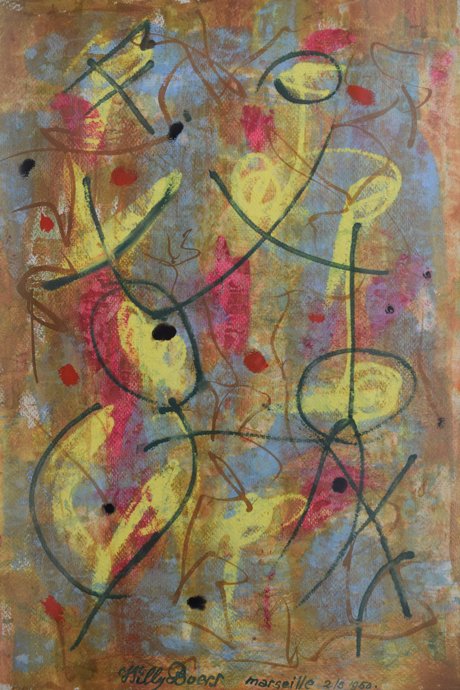
Boers produced a large body of gouaches on paper, such as the bright 1955 works the Bundesbank bought. Miró’s own work on paper shows how much spontaneity and colour a small, quick medium can hold.
Boers’ works carry titles like Vluchtig moment (“Fleeting moment”) and Imaginative activity, which hint at a mood or a process instead of naming a subject. That is close to the spirit of Miró, whose titles invite the viewer in without fixing a meaning.Vrij Beelden deliberately drew on Cubism, Surrealism and Expressionism together. Miró lived in exactly that overlap, never fully Surrealist, never fully abstract, always inventing. It’s easy to see why that attitude appealed to a group wanting to renew painting without a clean break from the past.
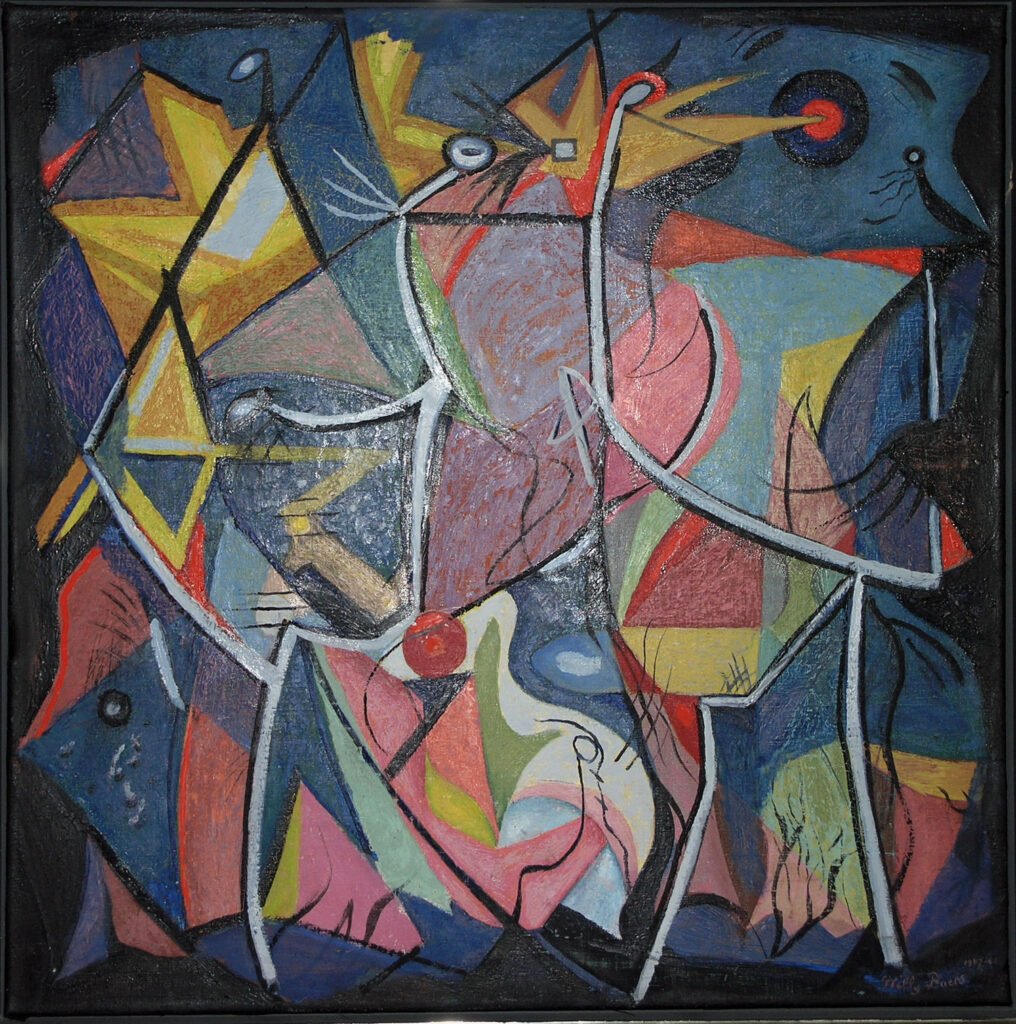
It would be a mistake to call Boers a Miró follower. He absorbed many voices, and his path kept moving. In the 1960s and 1970s he experimented with geometric abstraction, collage and matter painting, increasingly influenced by the American abstract expressionists. He was also a thinker as well as a painter. He wrote many articles on abstract art.
Miró, then, was one thread in a larger weave, alongside Klee, Kandinsky and the École de Paris. What links them is the sense that painting could be a free, inventive language rather than a window onto the world.
Boers is represented in the collections of the Rijksmuseum in Amsterdam and the Cobra Museum in Amstelveen. If you’re in the Netherlands, they’re worth a visit, and a good place to judge for yourself where Miró’s playfulness shows up.
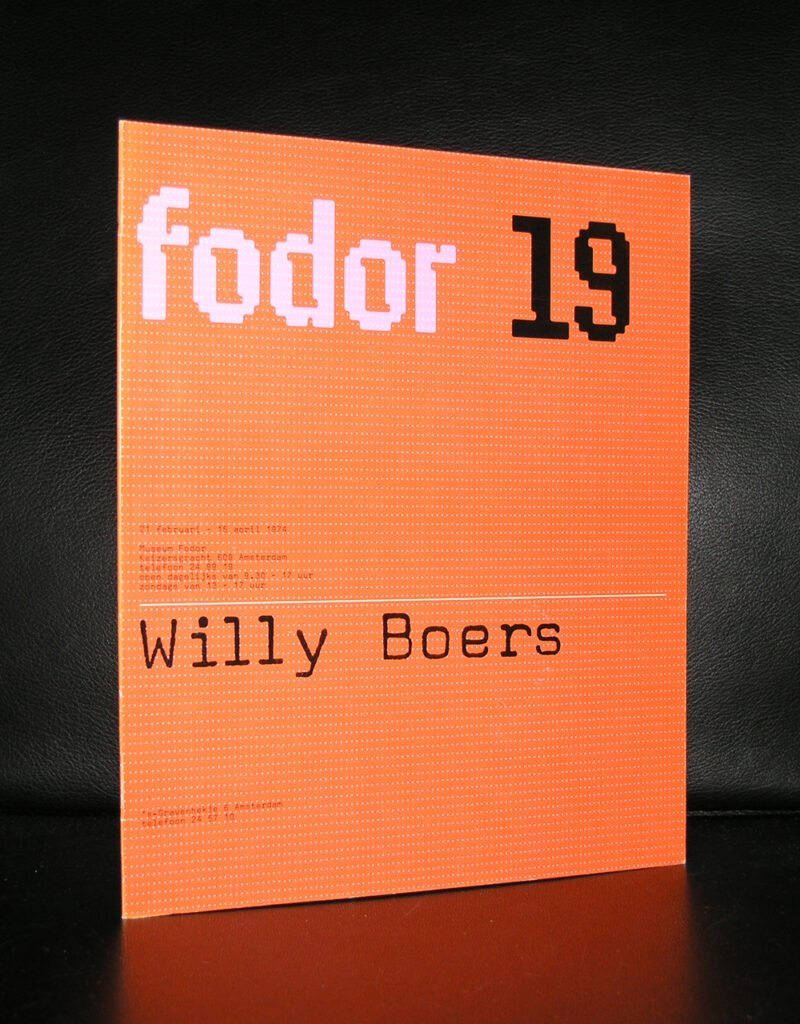
www.ftn-books.com has several publications on Boers now available.
Share this post
- Tags: miro, vrij beelden, willy boers