Yves Chaland
Posted by wilfried van den elshout on
The Crystal Clear Line: Why Yves Chaland’s Comic Art Matters Now More Than Ever
If you walk into a contemporary art gallery today, you’re likely to see a lot of things: immersive digital projections, text scrawled on walls, canvases that reject the very idea of representation. What you are unlikely to see is a simple, beautifully drawn comic panel about a 1950s robot.
And that, precisely, is why we need to talk about Yves Chaland.
In the history of European comics, Chaland is a shooting star—a brief, brilliant flash that burned out far too soon. He died in 1990 at the age of 33, killed in a car accident. But in his short career, he didn’t just draw comics; he weaponized nostalgia, perfected geometry, and created a visual language so precise it feels almost heretical in our age of digital chaos. For the modern art world, obsessed with deconstruction and irony, Chaland offers a radical counter-proposition: that the most subversive thing an artist can do in the 21st century is pursue absolute clarity.
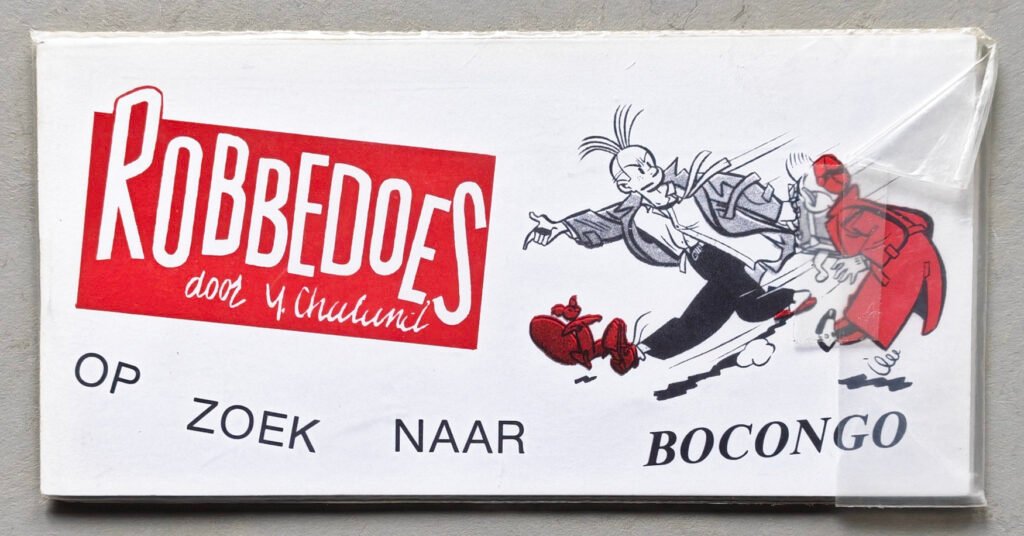
To look at a Chaland page is to enter a world that never quite existed. His most famous creation, Freddy Lombard, and his earlier masterpiece, The Adventures of Spirou and Fantasio (which he briefly resurrected in the early 80s), are set in a parallel-universe 1950s. It’s a world of bulbous, pastel-colored cars, Googie architecture, and men in sharp suits who look like they’ve stepped out of a Tintin album designed by a Danish furniture maker.
This style—known as the "Atomium Style" (named after the Brussels monument built for the 1958 World’s Fair)—is Chaland’s signature. It draws heavily from the Ligne Claire (Clear Line) pioneered by Hergé, but Chaland pushes it further, into the realm of the uncanny. Hergé’s lines were functional, a vessel for adventure. Chaland’s lines are the subject of the story. They are so deliberate, so stylized, and so rigidly controlled that the artifice itself becomes beautiful.
Every character exists in a grid. A round head might be balanced precisely against a rectangular briefcase, which is positioned next to a car with perfectly elliptical headlights. Reading a Freddy Lombard adventure like The Comet of Carthage or Holiday in Budapest feels less like reading a comic and more like touring an architectural model. It’s a world where emotion is conveyed not through expressive ink splatters, but through the stiff, almost mannequin-like posture of the characters.
Why does this matter today? We live in an era of "deskilling" in high art, where concept often trumps craft. Chaland represents the polar opposite: a defiant re-skilling. He was an artist so fluent in the language of design that he could construct a fake advertisement from 1954 that looks more authentic than the real thing.
There is a deep irony in Chaland’s work that the fine art world often misses. His 1950s isn’t a real 1950s; it’s a simulacrum, a fantasy of the atomic age filtered through the lens of the 1980s. He wasn’t just copying retro ads; he was dissecting them, amplifying their visual signifiers until they became something grotesque and magnificent. In this sense, Chaland was a postmodernist before the term was fully weaponized in the art markets. He understood that in a media-saturated age, authenticity is dead, and only the perfectly fabricated surface remains.
For modern audiences drowning in AI-generated imagery, Chaland’s hand-drawn perfectionism is a quiet act of rebellion. Every line in a Chaland book is utterly intentional. An AI can now mimic the Ligne Claire style in seconds, producing a blurry approximation of a Tintin cover. But an AI cannot replicate Chaland’s specific weight of line, his choice of a mustard-yellow against a teal blue, or his bizarrely static sense of timing. His art is a reminder that style is not just a visual filter; it is the residue of a human decision-making process
The Chaland revival is also timely because of his protagonists. Freddy Lombard and his friends Sweep (a nerdy, bespectacled sidekick) and Dina (a perpetually unimpressed girl) are anti-heroes for the modern age. They are lazy, greedy, and motivated almost entirely by the promise of a free meal or a quick franc. They stumble into adventures involving art thieves and international conspiracies, but they never become noble.
In The Elephant’s Graveyard, Freddy’s motivation isn’t justice; it’s chasing a debt someone owes him. This moral ambiguity, packaged in the brightest, most childlike visual style, creates a cognitive dissonance that is distinctly modern. It prefigures the wave of adult animation and comics that use "childish" aesthetics to tell deeply cynical stories—think BoJack Horseman or the works of Daniel Clowes. Chaland proved that the Clear Line doesn’t have to be for children; it can be a mask for existential pointlessness. Freddy Lombard is the sociopath in a mid-century modern living room.
Chaland’s influence is a hidden algorithm running through modern visual culture. You see his DNA clearly in pop surrealism, in artists like Mark Ryden or Marion Peck, who also fuse the nostalgic innocence of vintage illustration with dark undercurrents. You see it in the vector-art movement of the early 2000s, and in the flat, geometric illustration style that dominated tech start-up branding for a decade.
But more profoundly, Chaland challenges the Modern Art hierarchy that separates "fine art" from "illustration." A Chaland page belongs in a museum as much as a Warhol silkscreen does. Both artists dealt with mechanical reproduction and the commodification of imagery. The difference is that Chaland had to draw his own soup cans, perfectly, 25 times.
For today’s artists, particularly those working in sequential art, Chaland is a patron saint of rigor. He represents a path where one can be commercially accessible—drawing funny books about robots and killers—while maintaining a formalist severity that would make a Bauhaus professor weep. He teaches us that graphic design, illustration, and storytelling are not separate disciplines but a continuous spectrum of language.
We are 35 years past Yves Chaland’s death, and his corpus remains tantalizingly small. We are left with a handful of perfect albums—artifacts of a future-past that never arrived. In a chaotic world, his art offers the comfort of absolute order, yet simultaneously reminds us that this order is a fragile, artificial construction.
Perhaps that is his ultimate meaning for modern art today. As we try to navigate the noise of the algorithm, the deepfake, and the endless scroll, Chaland’s art whispers a different possibility: What if we just drew a perfect line? What if we made it so clean, so sharp, and so deliberate that it cuts through the noise entirely?
The robots in his comics often stand frozen, caught mid-motion. They are beautiful, obsolete machines trying to function in a world that doesn't make sense. Yves Chaland was our best mechanic for those machines. In his early death, he became a ghost in the machine himself—but his clear, crisp line is still humming, still perfectly calibrated, waiting for the rest of us to catch up.
www.ftn-books.com now the Robbedoes adventure " Op zoek naar Bocongo" available.