Ross Bleckner an extremely important oeuvre
Posted by wilfried van den elshout on
If you want to understand how painting survived — and mattered — through the AIDS crisis, the culture wars of the 1980s, and the long shadow of Conceptualism, you have to look at Ross Bleckner.
By the late 1970s, plenty of critics had declared painting dead, eclipsed by Minimalism and Conceptual art. Bleckner, trained at NYU alongside Sol LeWitt and Chuck Close and later at CalArts, didn't just keep painting — he made a case for why it still needed to exist. His early striped and geometric works absorbed the vocabulary of Op Art and hard-edge abstraction, but he pushed them somewhere stranger and more emotional, using light, blur, and glow to suggest that abstraction could still carry feeling, not just formal rigor.
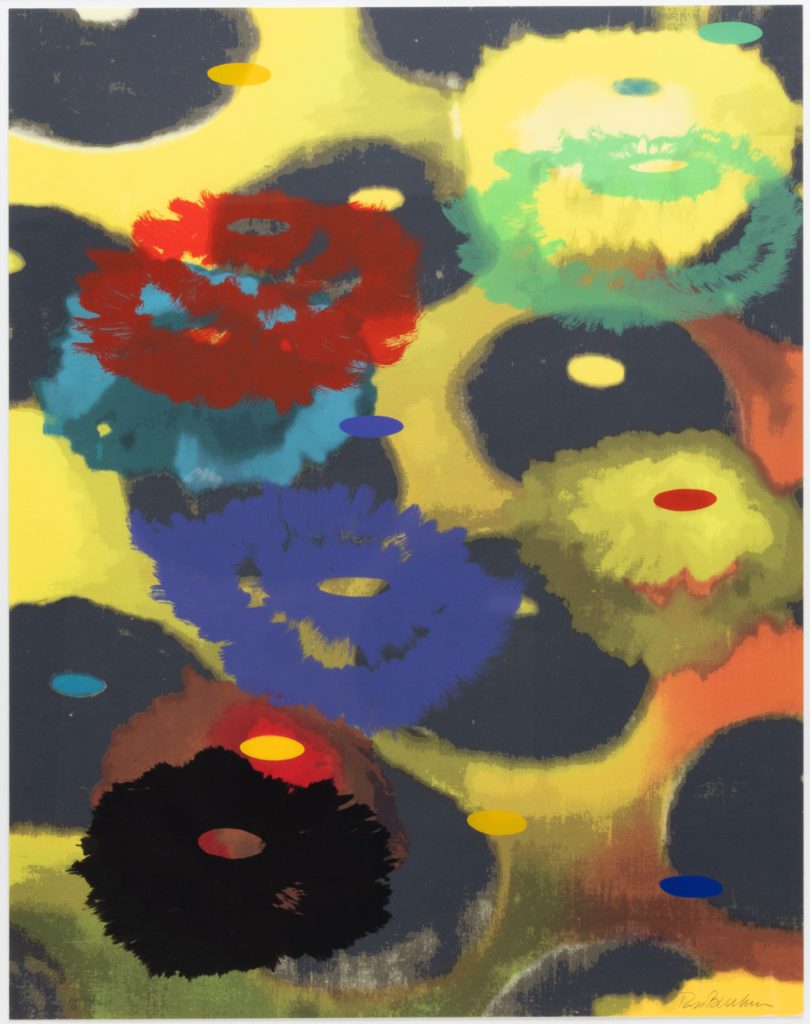
Bleckner's most consequential body of work emerged in the mid-to-late 1980s, when he began making paintings that responded — often obliquely — to the AIDS epidemic devastating the New York art world around him. Candelabras, urns, doves, cellular and vascular patterns, and pulsing fields of light became his visual language for loss, memory, and the fragility of the body. He didn't illustrate the crisis; he found a way to paint grief itself, giving abstraction a kind of emotional urgency that felt entirely new. That work remains one of the most sustained artistic responses to the epidemic, and it reshaped what people expected abstract painting to be able to do.
In 1995, at age 45, Bleckner became the youngest artist ever given a retrospective at the Guggenheim Museum — a milestone that cemented his place in the story of contemporary American painting and signaled that a new, more psychologically charged mode of abstraction had arrived. His work now sits in the permanent collections of MoMA, the Whitney, SFMOMA, the Reina Sofía, and the Astrup Fearnley Museum, among others.
Ross Bleckner isn't a historical footnote — he's a living link between the painting revival of the 1980s and the emotionally driven abstraction many artists are exploring right now. His work asks a question that still feels urgent: can a painting hold both formal beauty and real human loss at the same time? Decades into his career, he's still answering yes.
www.ftn-books.com added recently Bleckner to its collection.
Share this post
- Tags: aids, bleckner, mary boone