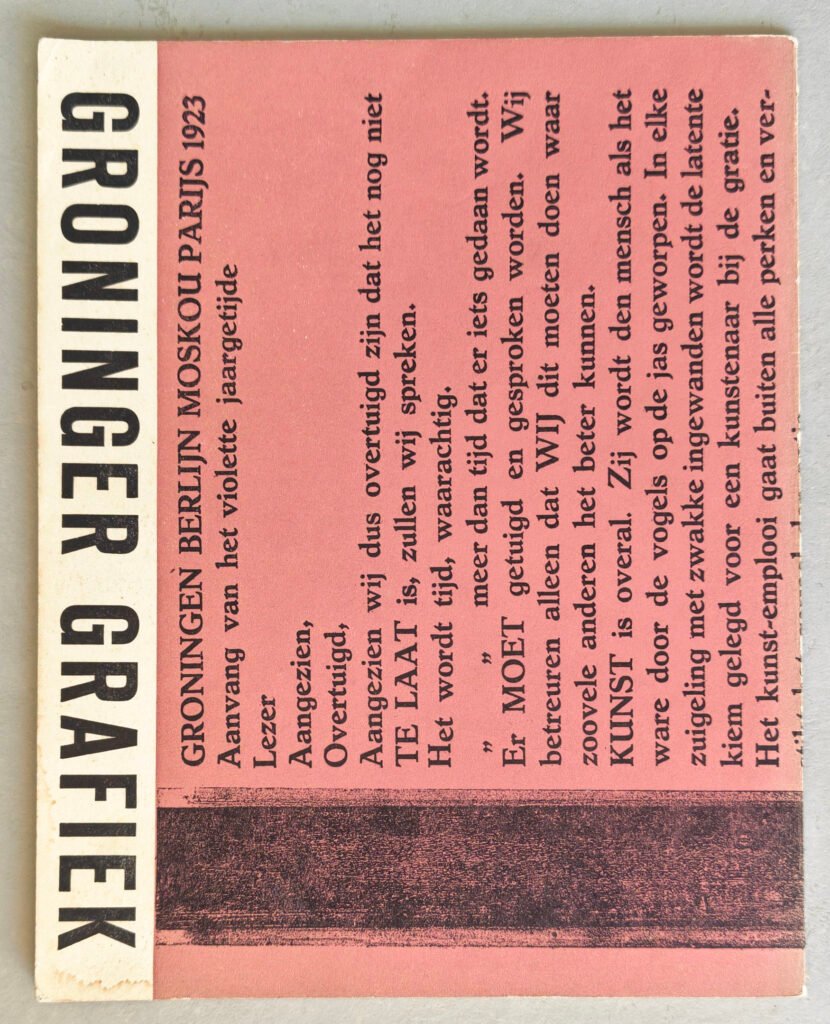
Groninger Grafiek
Posted by wilfried van den elshout on
Ink and Experiment: The New Graphic Art of Groningen
In the early 1900s, Groningen was not the first city that came to mind when people talked about modern art. Amsterdam and Paris got the headlines. But in this northern city, a quiet revolution was happening on the printing press.
The best-known figure is Hendrik Nicolaas Werkman (1882-1945). He ran a commercial print shop and made his living with ordinary jobs like letterheads, brochures and invitations. Yet he treated type, ink and paper as materials to play with, not just tools. In the 1920s he began making what he called druksels: experimental prints made by pressing and stamping type, rollers and found shapes into colourful, abstract compositions.
Werkman was close to De Ploeg, the Groningen artists’ collective founded in 1918, whose painters, such as Johan Dijkstra and Jan Wiegers, pushed expressionism and colour in a distinctly northern direction. Werkman joined that circle in 1920. While the painters worked on canvas, he brought the same energy to the printed page.
From 1923 to 1926 Werkman produced The Next Call, a handmade series of experimental printed sheets sent to friends and fellow artists. Letters tilt, overlap and break free of the grid, and the text becomes image. It was far ahead of its time, and it connected a provincial print shop to the international avant-garde of Dada, De Stijl and the Bauhaus.
What makes this movement special is how unglamorous it was. There were no grand studios, just a working printer in a regional city who decided that everyday craft could be art. His work still feels fresh today, and it is a reminder that innovation often happens far from the spotlight.
Werkman was executed by the Germans in April 1945 for his involvement in the resistance, but his prints, and Groningen’s place in modern graphic art, live on, not least at the Groninger Museum.
Later this year i will write a long blog on Werkman, one of the most influential artists from last century in the Netherlands.
In the meantime the HAAGS GEMEENTEMUSEUM catalog on these artists from 1960 is now available at www.ftn-books.com